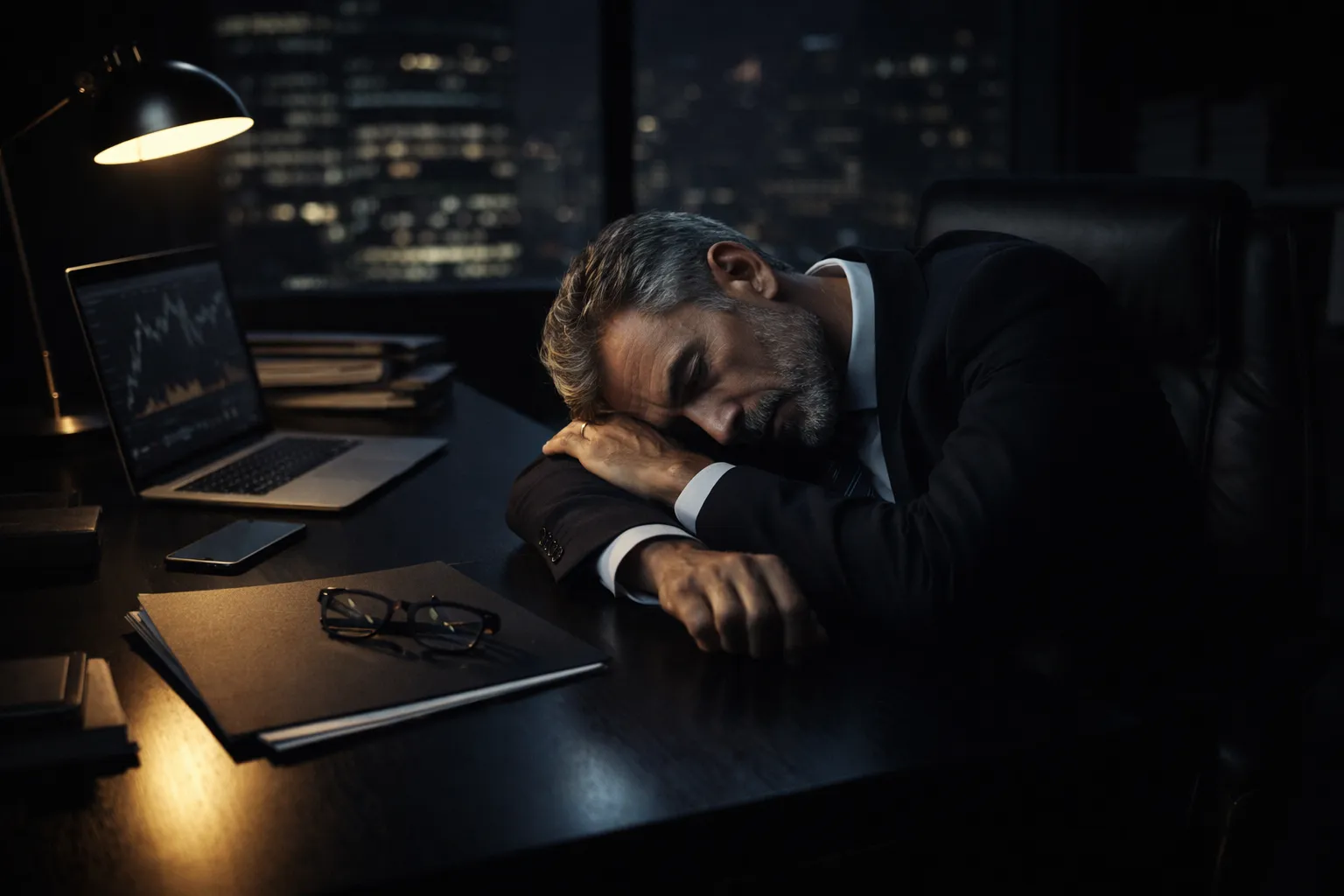
Why elite leaders now treat sleep as strategic infrastructure
For years, sleep was framed as a personal weakness in leadership culture. Short nights were worn as proof of commitment. Irregular schedules were normalized as the cost of responsibility. At the top, availability mattered more than recovery.
That framework is collapsing.
Not because of wellness culture.
Because of data.
A large-scale study conducted by Vitality in partnership with the London School of Economics, analyzing nearly 47 million nights of sleep, shows that consistency of sleep timing — not motivation, not discipline, not intensity — is directly associated with lower mortality risk, fewer hospitalizations and longer functional lifespan.
For executives, founders and owners, the conclusion is uncomfortable but unavoidable:
Sleep is no longer a lifestyle choice.
It is a leadership constraint.
What makes this study different
Most sleep research focuses on averages: hours per night, sleep debt, recovery windows. This study did something different.
It examined variability.
By tracking millions of nights across long time horizons, researchers identified a strong correlation between irregular sleep patterns and adverse long-term outcomes — even among individuals who slept “enough” hours overall.
Participants with consistent sleep schedules showed:
-
up to 31% lower risk of premature death
-
fewer emergency and long-term hospital admissions
-
better long-term health stability
The critical variable was predictability, not effort.
From a leadership perspective, this reframes the problem entirely.
Why consistency matters more than duration at the top
At senior levels, performance is no longer linear. Leaders are not producing output; they are maintaining systems of judgment.
That system depends on:
-
emotional regulation
-
tolerance for ambiguity
-
long-horizon thinking
-
resistance to noise and urgency
Sleep inconsistency degrades all of these — not immediately, but cumulatively.
Irregular sleep does not cause visible failure.
It causes subtle distortion.
Decisions become slightly shorter-term.
Risk tolerance narrows.
Emotional neutrality erodes.
These are the earliest signs of leadership decay — long before burnout is diagnosed.
The false belief in recovery
Many executives operate under a compensatory model:
-
short sleep during the week
-
recovery on weekends
-
periodic resets through travel or time off
The data suggests this model is flawed.
Physiologically, the human system adapts to rhythm, not recovery spikes. Constant variability forces repeated recalibration of hormonal cycles, cognitive readiness and stress response.
In leadership terms:
-
recovery restores energy
-
consistency preserves stability
Stability is what power depends on.
Sleep irregularity as a hidden leadership tax
The cost of inconsistent sleep is not exhaustion.
It is decision tax.
Over time, leaders experience:
-
increased decision fatigue
-
reduced capacity for delayed gratification
-
heightened sensitivity to short-term pressures
-
greater reliance on intuition over analysis under stress
None of this is visible on a calendar.
All of it shows up in outcomes.
Boards rarely ask about sleep.
Markets never price it directly.
But its effects compound quietly, like leverage.
Why elite leaders are changing behavior quietly
This shift is not being discussed publicly — and that is intentional.
Among senior executives, changes around sleep are happening in private:
-
fixed sleep and wake windows, regardless of workload
-
aggressive calendar boundaries in the evening
-
delayed decision-making for non-critical matters
-
reduced exposure to late-night communications
These adjustments are not framed as “self-care.”
They are treated as operational safeguards.
The language is different:
-
not “I need rest”
-
but “I need consistency”
Sleep as leadership infrastructure
Elite leaders already understand infrastructure:
-
legal structures protect downside
-
financial reserves preserve optionality
-
reputational buffers absorb shocks
Sleep consistency belongs in the same category.
It does not increase upside.
It reduces failure probability.
Over a 10–15 year leadership horizon, that reduction matters more than marginal gains in productivity.
The long-term advantage of predictability
Consistency creates a stable internal baseline. That baseline allows leaders to:
-
remain calm under prolonged uncertainty
-
resist artificial urgency
-
think in years instead of quarters
-
maintain authority without escalation
In volatile environments, calm is not personality.
It is biological capacity.
And biological capacity is governed by rhythm.
Why this is not a wellness story
This is not about balance, mindfulness or lifestyle optimization.
It is about:
-
longevity of effective leadership
-
preservation of cognitive authority
-
sustaining decision quality across decades
The study does not argue that leaders should sleep more.
It argues they should sleep the same way, every day.
That distinction is everything.
The uncomfortable conclusion
Inconsistency is expensive.
At the top, it is dangerous.
Leaders who treat sleep as negotiable are not buying flexibility. They are accumulating hidden risk — one that does not announce itself until control has already weakened.
The data now makes this visible.
And that is why executives are paying attention.