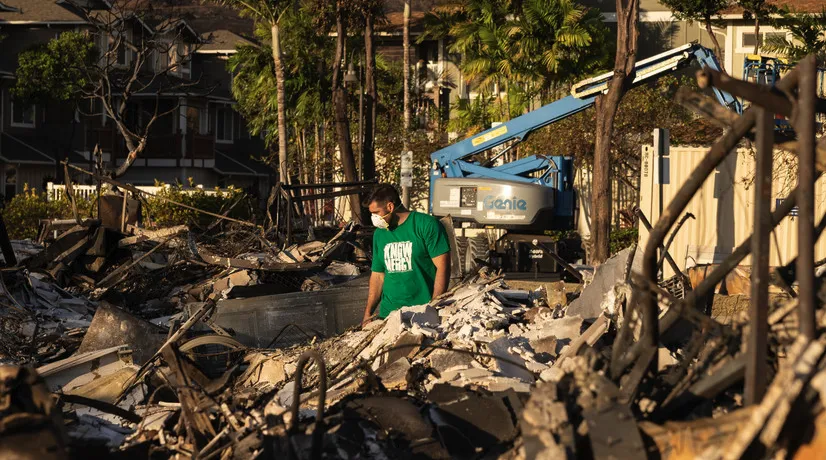
In recent years, cryptocurrency has gradually moved beyond speculation and trading into more practical use cases. One of the most notable — and often overlooked — applications is charitable giving. A high-profile example of this shift emerged after the devastating wildfires on the Hawaiian island of Maui, when Oprah Winfrey and Dwayne Johnson launched a relief initiative that openly accepted cryptocurrency donations.
The Maui wildfire crisis did not just expose weaknesses in emergency preparedness and housing resilience. It also highlighted how digital assets are increasingly being integrated into real-world humanitarian responses, especially when public trust, speed, and global reach matter.
The Maui Wildfires: A Humanitarian Emergency
In August 2023, a series of fast-moving wildfires swept across the island of Maui, destroying large parts of Lahaina and surrounding communities. Entire neighborhoods were reduced to ashes within hours. Thousands of residents were displaced, local businesses collapsed overnight, and the economic damage quickly reached into the billions of dollars.
Beyond the immediate loss of life and property, the disaster created a long-term humanitarian challenge. Many families lacked insurance, access to short-term housing, or liquidity to cover basic needs while waiting for federal or state assistance. Traditional relief mechanisms, while necessary, often proved slow and bureaucratic in the critical first weeks after the disaster.
This gap between urgency and response created space for alternative models of aid.
The People’s Fund of Maui: A Direct Cash Approach
In response to the crisis, Oprah Winfrey and Dwayne Johnson announced the creation of the People’s Fund of Maui, a charitable initiative designed to deliver direct financial assistance to affected residents rather than indirect aid tied to specific goods or services.
The concept was simple but powerful: provide cash payments directly to adults who had lost homes or livelihoods, allowing them to decide how best to use the funds. This model contrasted sharply with traditional disaster relief programs that often restrict spending or involve lengthy verification processes.
The fund launched with a personal contribution of approximately $10 million from the two celebrities, but its broader impact depended on attracting global donations — including from individuals outside the United States.
Why Crypto Donations Were Included
One of the most notable aspects of the People’s Fund of Maui was its decision to accept cryptocurrency donations, including:
-
Bitcoin (BTC)
-
Ethereum (ETH)
-
Dogecoin (DOGE)
While the fund also accepted standard fiat payments, the inclusion of crypto was not a marketing gimmick. It reflected a practical recognition of how modern donors hold wealth.
A growing segment of global donors — particularly younger and tech-savvy individuals — keep a meaningful portion of their assets in crypto rather than traditional bank accounts. For these donors, converting digital assets into fiat before donating introduces friction, tax complexity, and delays.
By accepting crypto directly, the fund lowered barriers to participation and enabled faster, borderless contributions.
Speed, Transparency, and Global Reach
Cryptocurrency offers three features that are especially valuable in disaster relief:
1. Speed
Crypto donations can be transferred within minutes, regardless of geographic location. In crisis situations, speed matters — not only for logistics, but for public confidence in relief efforts.
2. Global Accessibility
Donors from Europe, Asia, and emerging markets can contribute without navigating international banking systems, currency conversions, or high fees.
3. Transparency
Blockchain transactions are publicly verifiable. While recipients are protected through traditional distribution channels, donors can independently confirm that funds were sent and received.
For high-profile figures like Oprah Winfrey, whose reputation is closely tied to trust and accountability, these attributes are not optional — they are essential.
Celebrity Involvement and Public Trust
Celebrity-led charitable initiatives often attract skepticism, especially in the age of social media. Critics question motives, fund allocation, and long-term impact. In the case of the Maui relief effort, accepting crypto introduced an additional layer of scrutiny due to the asset class’s association with volatility and scams.
However, Oprah’s involvement fundamentally changed the perception of the initiative.
She is not known for speculative endorsements or hype-driven investments. Her public brand has been built over decades on credibility, philanthropy, and social impact. As a result, her participation acted as a trust anchor, reassuring donors that crypto was being used as a tool — not as a promotional angle.
Importantly, Oprah did not promote cryptocurrency itself. The focus remained squarely on helping displaced families, with crypto positioned as one of several ways to contribute.
Crypto Philanthropy Beyond Maui
The Maui case is part of a broader trend in which cryptocurrency is increasingly used for humanitarian aid:
-
Ukraine received hundreds of millions of dollars in crypto donations during the early stages of the war.
-
NGOs and disaster relief organizations now routinely list crypto wallets alongside bank accounts.
-
Blockchain analytics tools are being used to track aid flows and reduce corruption risks.
What sets the Maui initiative apart is not the novelty of crypto donations, but the mainstream cultural legitimacy brought by Oprah Winfrey’s involvement.
For many observers, this marked a quiet but important shift: crypto philanthropy was no longer limited to niche communities or tech insiders.
Addressing Concerns and Misuse
At the same time, the visibility of Oprah’s name in crypto-related contexts has had unintended consequences. Scammers have repeatedly used deepfake videos, fake interviews, and fraudulent ads falsely claiming that she endorses crypto investment schemes.
The Maui initiative highlights a critical distinction that is often lost in online misinformation:
Accepting crypto donations is not the same as promoting crypto investment.
In the Maui case, cryptocurrency functioned as a payment rail, not a speculative asset. Donations were converted and distributed through regulated, transparent channels. This distinction is essential for both regulators and the public to understand as crypto adoption expands.
What This Means for the Future of Disaster Relief
The success of crypto-enabled donations for Maui suggests several long-term implications:
-
Hybrid models combining fiat and crypto will become standard in large-scale relief efforts.
-
Celebrity-led initiatives may increasingly adopt blockchain tools to enhance transparency and global reach.
-
Crypto’s reputation may gradually shift from speculative excess to practical infrastructure.
For crypto skeptics, the Maui case offers a grounded example of real-world utility. For crypto advocates, it demonstrates that mass adoption does not require hype — it requires trust, restraint, and alignment with human needs.
Conclusion
Oprah Winfrey’s involvement in crypto-enabled disaster relief for Maui does not signal a pivot into Web3 evangelism or digital asset promotion. Instead, it reflects something far more significant: the normalization of cryptocurrency as a neutral financial tool.
By quietly integrating crypto into a high-stakes humanitarian response, the People’s Fund of Maui showed how digital assets can complement traditional systems rather than replace them. In moments of crisis, what matters most is not ideology, but effectiveness.
And in that sense, the Maui wildfire relief effort may represent one of the clearest examples yet of crypto moving beyond theory — and into meaningful action.